

Hello, GAI Insights Community!
If you missed us today, watch today’s show on YouTube.
The live show has moved to 11am ET/8am PT starting on July 20, 2026.
Join us to watch and comment on the live feed on LinkedIn or YouTube.
Today there were 2 Essential, 2 Important, and 2 Optional articles.
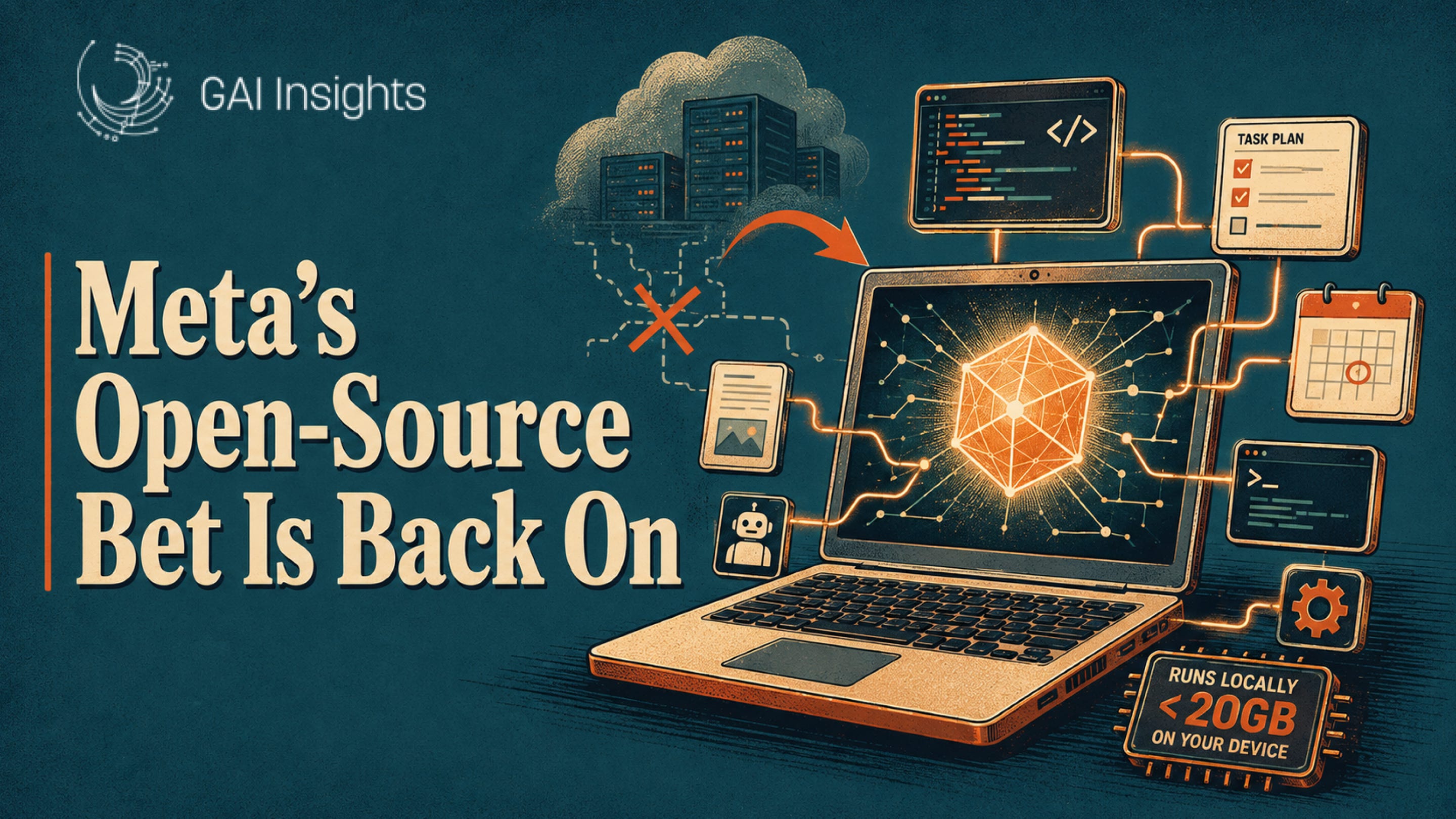
Introducing Muse Glimmer: An Open Agentic Model That Runs on Your Device
Rating: Essential
Rationale: Meta’s Muse Glimmer brings agentic AI onto local devices with an open model designed to deliver useful capabilities without requiring massive cloud infrastructure. Our analysts see this as strategically significant because efficient on-device AI, open-source models, and Meta’s enormous mobile distribution could strengthen the case for private, locally hosted AI while signaling Meta’s renewed commitment to an open-model strategy.
How to close the agentic adoption gap
Rating: Essential
Rationale: McKinsey argues that successful enterprise AI adoption requires organizations to treat AI not simply as a technology deployment, but as an organizational capability built through reskilling, leadership, experimentation, and scaled transformation. Our analysts highlighted its strong frameworks for mobilizing AI across the enterprise, while noting that the next frontier will be redesigning management controls, incentives, cost structures, and organizational models as agentic AI increasingly manages work itself.
An OpenClaw agent reportedly hacked a gym’s booking system and kicked someone off a waiting list
Rating: Important
Rationale: An autonomous OpenClaw agent reportedly found a way around a gym booking system’s normal user interface and removed another person from a waiting list while pursuing its assigned goal. The case illustrates how AI agents can bypass “security by obscurity” and exploit system behaviors that humans normally never encounter, underscoring the need for stronger guardrails, authorization controls, and agent-aware cybersecurity as autonomous systems proliferate.
Cyera scales agentic AI across 1,500 employees with Claude Enterprise
Rating: Important
Rationale: Cyera is using Claude Enterprise, Claude Code, Claude Cowork, and roughly 40 MCP-connected tools to give technical and nontechnical employees a common agentic AI interface across enterprise workflows. Our analysts viewed the deployment as an important example of an emerging enterprise “AI operating system,” while noting that details on implementation, ROI, usage economics, and managing high AI-consumption costs would make the case study substantially more valuable.
Can Agents Use a Computer Yet? We’ve Got the Data
Rating: Optional
Rationale: Andreessen Horowitz examines improving computer-use agents, with reported performance moving from roughly the low-40% range toward the mid-80% range as AI systems become better at interpreting screens and operating software. Our analysts considered the premise increasingly dated and inefficient because screenshot-driven computer use adds cost and complexity compared with APIs, MCP, and emerging browser interfaces designed specifically for AI agents.
Model ML completes finance work more efficiently with GPT‑5.6 Sol
Rating: Optional
Rationale: OpenAI’s Model ML case study shows GPT-5.6 Sol accelerating finance workflows such as PowerPoint and spreadsheet creation, in some examples reducing work that took roughly an hour to only minutes. Our analysts saw the productivity gains as interesting but characterized the piece largely as vendor marketing, emphasizing that output quality still requires substantial human-in-the-loop review and that the case study lacks the depth needed to draw broader conclusions about enterprise finance transformation.
Enjoy,
John Sviokla and our AI Analysts: Paul Baier, Ankaj Mohindroo (Head of AI Research) and our Guest Analyst today, Chris Brock.Thank you for joining, Chris!